Updated: July 2026
Liveaboard vs. Resort for a Raja Ampat Photography Expedition
- Mobility: Liveaboards cover hundreds of nautical miles, reaching disparate biomes like Misool and Wayag in a single trip.
- Immersion: Resorts allow for in-depth exploration of a specific area, enabling photographers to revisit sites in varying conditions.
- Workflow: Resorts provide more space for gear maintenance and editing, while liveaboards offer a more dive-intensive schedule.
The First Light Decision
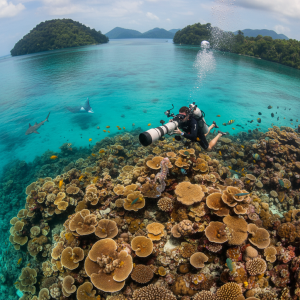
The air is thick with the scent of salt and damp rainforest, a fragrance unique to this corner of the world. It’s 5:30 AM. The gentle thrum of the generator is the only sound breaking the pre-dawn stillness. You stand on the dive deck, the weight of your Nauticam housing a familiar comfort in your hands. Below, the water is an impossible cobalt, hinting at the universe of life that awaits. This is the moment of decision, the critical juncture for any serious photographer planning a trip to the world’s last true marine Eden. Do you make this your home base for the next ten days, a floating studio 1,500-plus islands of the archipelago? Or do you trade this nomadic existence for a fixed, terrestrial base, a private bungalow from which to launch surgical strikes on the surrounding reefs? This choice—liveaboard versus resort—will define every frame you capture on your **raja ampat photography expedition**. It is not a question of which is better, but which is the superior tool for the specific images you intend to create.
Mobility vs. Immersion: The Central Photographic Debate
At its core, the choice between a floating platform and a land-based one is a strategic decision between geographic breadth and hyperlocal depth. Raja Ampat is not a single destination; it is a sprawling maritime province covering over 46,000 square kilometers. To put that in perspective, it’s an area roughly the size of Switzerland, but comprised almost entirely of water and limestone karst islands. A liveaboard is, without question, the most efficient instrument for traversing this immense territory. On a typical 10-night itinerary, a vessel like the Damai II or the Amandira might cover 300 nautical miles, transporting you from the teeming fish schools of the Dampier Strait to the ethereal soft coral gardens of southern Misool. This mobility is the liveaboard’s superpower. It allows a photographer to build a diverse portfolio showcasing the full ecological spectrum of Raja Ampat. One day you are shooting wide-angle scenes of schooling jacks at Sardine Reef; 48 hours later, you are hunting for pygmy seahorses on gorgonian fans 100 miles south.
Conversely, a resort offers the gift of immersion. By basing yourself at a location like Misool Eco Resort or Papua Paradise, you commit to deeply understanding a single, albeit rich, slice of the environment. This approach trades variety for mastery. It allows you to dive the same site—say, the legendary Cape Kri, where Dr. Gerald Allen famously identified 374 fish species on a single dive—at 8 AM, at noon, and again on a dusk dive. You learn the currents, the cleaning stations, and the precise moment the light will strike a particular coral bommie. This repetition is invaluable for perfecting a specific shot, whether it’s a complex motion-blur pan of a passing manta ray or a backlit portrait of a mandarinfish. For the photographer with a singular vision, the resort becomes a fixed-point observatory for capturing a masterpiece.
The Liveaboard Advantage: A Floating Studio in the World’s Most Remote Waters
The primary argument for a liveaboard-based **raja ampat photography expedition** is access. There are simply parts of this archipelago that are logistically unfeasible to reach from a land-based operation on a day-trip basis. The iconic, mushroom-shaped islands of Wayag in the north, or the labyrinthine lagoons of Misool in the south, require multi-day sea voyages. A liveaboard transforms these remote outposts from an expeditionary challenge into your daily backyard. You wake up, not to the prospect of a two-hour speedboat ride, but already anchored in the center of the action. This proximity means more time in the water and access to sites at optimal times, like dawn and dusk, when boat traffic is non-existent and marine life is most active.
From a workflow perspective, modern luxury liveaboards are designed with the photographer in mind. Vessels we recommend for a Raja Ampat photo tour feature climate-controlled camera rooms with individual stations, ample charging points (both 110V and 220V), and large rinse tanks dedicated solely to camera equipment. The daily rhythm is intense and efficient: dive, eat, download images, prepare for the next dive. It’s a focused, distraction-free environment. You are surrounded by 10 to 15 other guests who share your passion, creating a collaborative atmosphere where techniques and critiques are exchanged over dinner. This floating think-tank environment can be as valuable as the diving itself. While cabin space is inherently more compact than a resort bungalow, the trade-off is an sense of discovery. Each morning brings a new vista, a fresh set of reefs, and a different story to tell with your lens.
The Resort-Based Expedition: A Bastion of Space and Deliberate Practice
Opting for a resort is a declaration of intent. It says you value space, stability, and the luxury of time. For the photographer traveling with a significant amount of equipment—multiple housings, extensive lighting rigs, drones, and laptops for editing—a resort provides an unbeatable home base. Imagine a sprawling, 50-square-meter overwater bungalow as your personal studio. You can have your entire kit laid out, batteries charging on a dedicated desk, while you perform meticulous O-ring maintenance without feeling cramped. This space is not just a convenience; it is a critical component of a successful, stress-free shoot in a humid, saltwater environment where gear failure is a constant threat.
The pace at a resort is inherently more relaxed and customizable. While dive centers offer structured schedules, there is greater flexibility. Perhaps the light isn’t right for underwater work one afternoon. You can pivot to a land-based shoot, seeking out the endemic Red Bird-of-Paradise in the nearby forest, a project nearly impossible from a liveaboard. Or you can simply take the afternoon to edit, backing up files with a relatively stable (if slow) internet connection—a luxury unheard of on most liveaboards, which are often offline for the entire trip. This control over your own schedule allows for a more contemplative approach to photography. You are not just collecting a series of disconnected images from across the region; you are building a cohesive body of work centered on a specific place, a visual essay on a single, extraordinary ecosystem. This deliberate practice is how iconic, award-winning images are often made.
Subject Matter and Photographic Goals: Aligning Platform with Portfolio
The decision ultimately hinges on your photographic objectives. Are you a generalist aiming to capture the sheer scale and variety of Raja Ampat for a feature in a publication like Indonesia Travel? The liveaboard is your platform. It’s the only way to photograph Misool’s Boo Windows, the Dampier Strait’s manta gatherings, and Wayag’s dramatic landscapes within a single 12-day trip. Your portfolio will scream diversity, showcasing the region’s status as the epicenter of marine biodiversity, a key reason for its consideration as a UNESCO World Heritage site. Each day presents a new environment, from black volcanic sand muck dives to vibrant, current-swept pinnacles. This is the quintessential survey expedition.
Conversely, are you a specialist obsessed with a particular subject? Perhaps your goal is to create the definitive portfolio on the Denise’s pygmy seahorse (Hippocampus denise), which lives on specific gorgonian sea fans. A resort located in an area rich with these fans, like Kri Island, is the superior choice. Your guides will know the exact location of several colonies, and you can spend dive after dive patiently waiting for the perfect behavior, experimenting with snoots and diopters. This is how you move beyond documentary shots and into the realm of fine art. The resort model supports this singular focus. Photographers on our specialized underwater photography workshops often choose a resort to hone one specific skill, be it blackwater diving or split-shot over-unders, with the logistical support and repetition that only a fixed base can provide. Your choice of platform is the first and most important creative decision you will make.
Quick FAQ for the Discerning Photographer
What is the better option for a non-diving partner?
Without a doubt, a resort is the superior choice. While a non-diver can enjoy the scenery from a liveaboard, options are limited. High-end resorts offer spas, kayaks, village tours, cooking classes, and private beaches, providing a full luxury vacation experience for a partner who isn’t spending six hours a day underwater.
Is it possible to combine both experiences?
Absolutely. The ultimate **raja ampat photography expedition** often involves a hybrid approach. Many of our clients book a 7- or 10-night liveaboard trip to cover the vast, remote areas and then decompress for 3-4 nights at a luxury resort. This allows them to sort and begin editing their images in a spacious environment while still enjoying some relaxed local diving.
How does seasonality impact the liveaboard vs. resort decision?
The primary diving season runs from October to April, when seas are calmest. During this period, both options are excellent. However, a liveaboard has a distinct advantage during the shoulder months or if localized weather patterns turn unfavorable. A captain can simply navigate the vessel to a different part of the archipelago where conditions are better, an impossibility for a fixed resort.
What is the general cost comparison?
On a per-night basis, a top-tier luxury liveaboard and a high-end eco-resort are often comparable, typically ranging from $700 to over $1,200 USD per person. The key difference lies in what’s included. Liveaboard rates are almost always all-inclusive (accommodation, all meals, and up to 4-5 dives per day). Resort pricing is often a-la-carte, with a base rate for the room and meals, and diving packages charged separately. For a dive-intensive trip, a liveaboard can offer better value.
Ultimately, there is no single correct answer. The debate between a mobile vessel and a fixed sanctuary is a personal one, dictated by your artistic vision, your tolerance for tight quarters, and your definition of luxury. The goal is to align your chosen platform with your photographic ambitions. Do you want a sweeping visual epic of the entire Four Kings region, or an intimate, character-driven portrait of a single reef? Answering that question is the first step in crafting your journey. Your portfolio deserves more than a simple vacation; it demands a meticulously planned expedition. Let us help you design your definitive raja ampat photo tour and ensure that every moment, both above and below the water, is perfectly framed.