Updated: July 2026
The Pro's Checklist: Essential Underwater Camera Gear for Raja Ampat
Raja Ampat Photo Tour is a curated Indonesia luxury tourism experience offered by Rajaampat Phototour Co.: handpicked routes, vetted operators, transparent pricing, and 24/7 concierge support across Indonesia.
- What makes Raja Ampat Photo Tour a premium experience.
- How Rajaampat Phototour Co. curates exclusive access and concierge logistics.
- Routes, seasons, and pricing transparency — no hidden fees.
The Pro’s Checklist: Essential Underwater Camera Gear for Raja Ampat
Embarking on a Raja Ampat photo tour is an investment in photographic opportunity. The region’s staggering biodiversity, from pygmy seahorses to majestic manta rays, demands a camera system that is both versatile and reliable. This is not a destination for casual gear choices. A well-considered kit is the foundation upon which you will build your portfolio, ensuring you can capture the full spectacle of the Coral Triangle’s epicentre, from its vibrant reefs to its iconic island landscapes. Coral Triangle initiative
Your Camera and Housing: The Heart of Your Rig
The choice of camera system—be it a high-end compact, mirrorless, or DSLR—forms the core of your creative toolkit. While each format has its merits, for a dedicated Raja Ampat photo tour, we find that full-frame or APS-C mirrorless systems currently offer the best balance of image quality, low-light performance, and travel-friendly size. The ability to shoot in low light with minimal noise is particularly crucial when shaded swim-throughs of Misool or capturing the crepuscular antics of mandarinfish near Arborek. West Papua tourism
Regardless of the camera body, the housing is its non-negotiable life support system. Leading brands like Nauticam, Aquatica, and Isotta offer robust aluminium housings with excellent ergonomics, allowing intuitive access to all essential camera controls. Do not underestimate the importance of this. Fumbling for a dial while a rare Wobbelgong shark rests perfectly on the reef is a frustrating experience. A critical feature to insist upon is a vacuum leak detection system. The peace of mind afforded by a green light confirming a perfect seal before you descend into the deep blue is invaluable in such a remote environment.
Lenses and Ports: Your Window to the Underwater World
Your lens and port combination dictates your entire photographic perspective. Raja Ampat’s subjects range from vast, reef-scapes to minuscule critters, and your equipment must be able to adapt. Bringing a versatile lens selection is not a luxury; it is a necessity for any serious photographer aiming to do justice to the region’s diversity.
Wide-Angle: Capturing the Scale of Raja Ampat
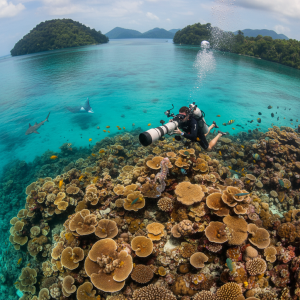
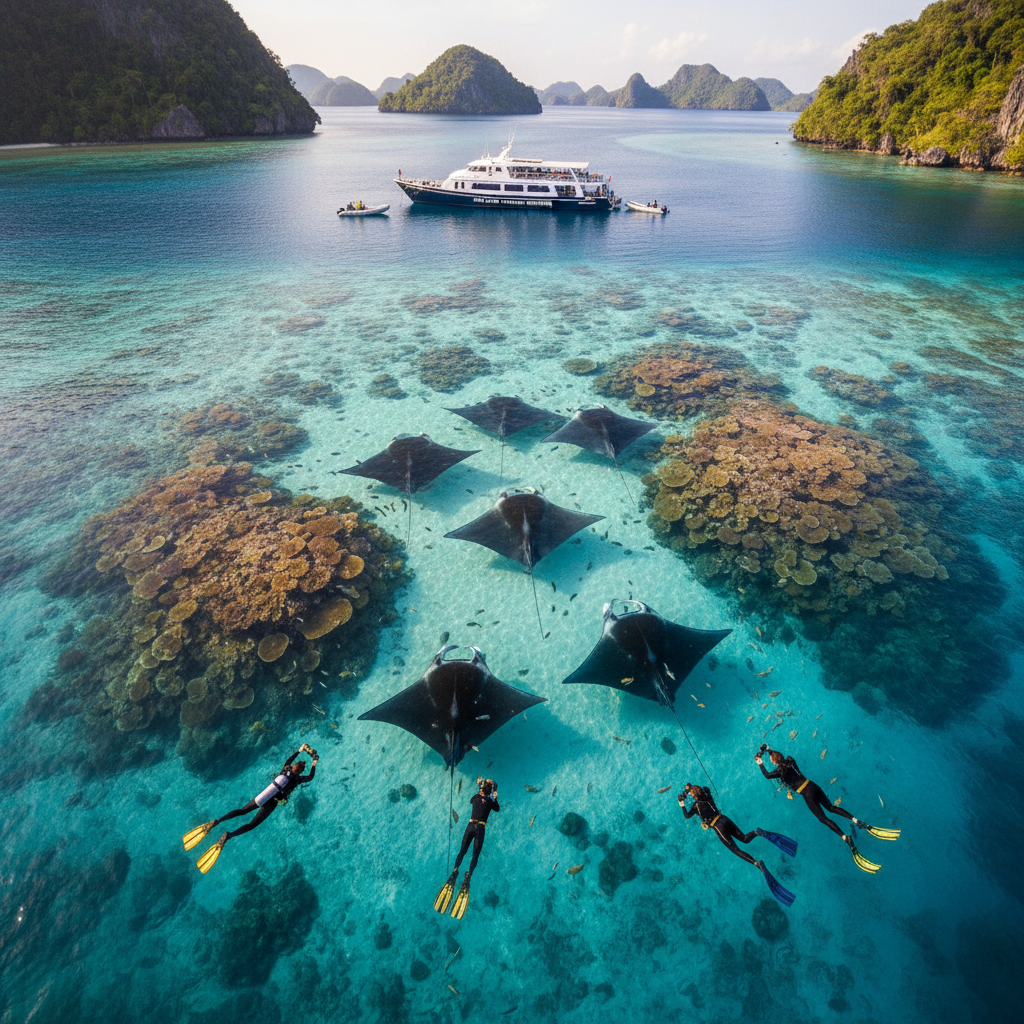
To capture the grandeur of Raja Ampat—the schooling barracuda in Kabui Bay, the soft coral gardens of the Fam Islands, or the sun-drenched jetties teeming with life—a wide-angle lens is essential. A fisheye lens (such as an 8-15mm) paired with a large glass dome port is the classic choice for immersive, close-focus wide-angle shots. It allows you to get incredibly close to a foreground subject, like a vibrant sea fan, while retaining the sweeping reef and blue water in the background. A rectilinear wide-angle zoom (like a 16-35mm) offers more compositional control for subjects like manta rays, reducing the distortion inherent in a fisheye.
Macro: Unveiling the Microscopic Wonders
At the other end of the spectrum, Raja Ampat is a macro photographer’s paradise. The region is famous for its cryptic critters, from the tiny Denise’s pygmy seahorse to the kaleidoscopic range of nudibranchs. A dedicated macro lens, typically in the 90mm to 105mm range, is the primary tool for this work. This focal length provides a comfortable working distance, allowing you to illuminate your subject without startling it. To push your creativity further, consider packing a wet-mount diopter. These accessory lenses screw onto the front of your port underwater, enabling super-macro capabilities for capturing the astonishing detail of a skeleton shrimp or a blenny’s eye.
Lighting: Strobes, Video Lights, and Arms
Water absorbs light and colour, beginning with red, even in the first few metres of depth. To reveal the true, vibrant colours of Raja Ampat’s reefs, artificial light is not optional. A powerful and flexible lighting system is as important as your camera and lens. The on-camera flash is functionally useless underwater, serving only to illuminate the water particles between you and your subject, a phenomenon known as backscatter.
A pair of external strobes is the standard for serious still photography. Two light sources allow for more even illumination, reduce harsh shadows, and provide the creative flexibility to model light for dramatic effect. Look for strobes with high guide numbers (a measure of power), fast recycle times, and wide, even beam angles. Connecting them via fibre-optic cables is often the most reliable method. For those shooting video, high-lumen, wide-beam constant video lights are required to ensure smooth, professional-looking footage. Ensure they have a high Colour Rendering Index (CRI) to reproduce colours accurately.
Your strobes or video lights are mounted on a system of arms and clamps. This is not the place to economise. A sturdy, easily adjustable set of arms (from brands like Ultralight Control Systems or Inon) allows for precise positioning of your lights. Mastering techniques like inward lighting to control backscatter in the nutrient-rich waters is impossible without a good arm system. It is the skeleton of your rig, providing the structure needed for creative lighting.
Essential Accessories: The Details that Matter
Success on a Raja Ampat photo tour often hinges on the small things. These accessories may seem minor, but their absence can compromise a dive or even an entire trip.
- Focus Light: In low light or on night dives, your camera’s autofocus will struggle. A dedicated focus light mounted on your housing provides a beam for the camera to lock onto, ensuring sharp images.
- Batteries and Memory Cards: Bring at least three batteries for your camera and two for each strobe, along with the corresponding chargers. Memory card capacity should be ample; shooting in RAW format fills cards quickly. A minimum of two 256GB high-speed cards is a sensible starting point.
- Viewfinder Magnifier: An external magnifying viewfinder, either straight or angled, attaches to the housing’s eyepiece. It makes critical focus and composition significantly easier, especially for those with less-than-perfect eyesight.
- Laptop and Hard Drives: A reliable laptop for daily image review and backup is crucial. Follow the 3-2-1 backup rule: three copies of your data, on two different types of media, with one copy stored off-site (or at least in a separate bag from your primary drive).
Maintenance and Redundancy: Preparing for the Remote
You are hundreds of kilometres from the nearest camera shop. Equipment failure without a backup plan can be catastrophic. A field maintenance kit is non-negotiable. This should include spare o-rings for every seal on your housing and ports, high-quality silicone grease, a lens cloth and cleaning solution, and a small air blower to remove dust and sand. A basic tool kit with appropriate screwdrivers and hex keys is also wise.
The professional’s mantra is “two is one, and one is none”. While bringing a complete backup for every component is impractical for most, consider redundancy for the most critical and fragile items. A spare sync cord, an extra battery charger, or a backup strobe are sensible investments. If your budget and baggage allowance permit, a secondary camera body—even a high-quality compact in a simple housing—can save your trip if your primary system floods.
Beyond the Underwater: Topside and Aerial Gear
A Raja Ampat photo tour offers spectacular opportunities above the water as well. To neglect topside photography would be to miss half the story. The iconic karst island seascapes of Wayag and Pianemo demand a good landscape lens. A circular polarising filter is essential for cutting through the tropical glare, deepening the blue of the sky, and saturating the turquoise hues of the water.
For wildlife enthusiasts, the mornings are dedicated to finding endemic birds. A long telephoto lens (e.g., 100-400mm or 200-600mm) is necessary to capture compelling images of the Wilson’s Bird-of-Paradise or the Red Bird-of-Paradise during their dawn displays. Finally, a drone can provide a striking perspective of the island labyrinths, but be sure to verify current regulations and fly responsibly, respecting both wildlife and local communities. A lightweight travel tripod is also invaluable for capturing sharp, long-exposure images during the golden hours of sunrise and sunset.
The Final Word: Packing Smart for Your Raja Ampat Photo Tour
Assembling your gear for a Raja Ampat photo tour is a process of careful consideration. Your goal is to build a system that is comprehensive, reliable, and versatile enough to handle any situation the world’s most biodiverse marine ecosystem presents. Every piece of equipment, from the main housing to the smallest spare o-ring, should be checked, double-checked, and packed with purpose.
This preparation frees you from worrying about your equipment once you are on board our liveaboard. It allows you to focus your energy where it truly matters: on observing marine behaviour, refining your composition, and immersing yourself in the creative process. A well-prepared photographer is a successful photographer, ready to translate the beauty of Raja Ampat into a lasting and powerful portfolio of images.
Frequently Asked Questions
What is the single most important lens for a Raja Ampat trip?
If you could only bring one underwater lens, a fisheye zoom (like an 8-15mm) offers the most versatility. It excels at capturing the grand reef scenes Raja Ampat is famous for, while also allowing for creative close-focus wide-angle shots of larger subjects. It defines the classic, immersive underwater photograph that screams “Raja Ampat.”
Is one strobe enough for underwater photography in Raja Ampat?
While one strobe is functional, two are highly recommended for serious photography. A dual-strobe setup provides more even lighting, eliminates harsh shadows, and offers far greater creative control. For capturing the vibrant, sprawling soft coral gardens of Misool without significant shadow areas, two strobes are almost a necessity for high-quality results.
How do I manage battery charging on a liveaboard?
Our vessels are equipped with dedicated camera rooms with ample charging stations (both 220V and 110V). However, it is wise to bring a multi-socket power strip to charge multiple items simultaneously from a single outlet. Always bring at least three batteries for your camera and two sets for each strobe to ensure you never miss a dive due to a dead battery.
Are there specific challenges with humidity for camera gear in West Papua?
Yes, tropical humidity is a constant factor. Keep your camera inside its sealed housing as much as possible, especially in the air-conditioned interior of the boat. When changing lenses, do so quickly in the driest environment possible. Pack several packets of reusable silica gel desiccant to store with your gear to absorb ambient moisture and prevent fogging.
What are the regulations for flying a drone in Raja Ampat?
Drone regulations in Indonesia, particularly in protected marine parks like Raja Ampat, are subject to change. A permit is generally required. It is crucial to check the latest rules with the local authorities or your tour operator before you travel. Always fly with respect for wildlife and local communities, and never launch or land from the boat while it is moving.
Is a full-frame or crop-sensor camera better for this trip?
Both have advantages. Full-frame cameras typically offer better low-light performance and dynamic range, which is excellent for wide-angle scenes. Crop-sensor (APS-C) cameras provide extra “reach” with macro lenses, making it easier to fill the frame with small subjects like pygmy seahorses. The best choice depends on your primary photographic interest.
Should I bring a dedicated video camera or use my hybrid stills camera?
Modern mirrorless and DSLR cameras shoot excellent 4K video. For most photographers, using their hybrid camera for both stills and video is the most efficient solution. Unless you are a dedicated videographer requiring specialised features like advanced audio inputs or specific log profiles, your primary camera will be more than capable of capturing remarkable footage.
How much memory capacity should I bring?
You can never have too much. Shooting in RAW format, especially with high-resolution cameras, consumes significant space. We recommend a minimum of 512GB of total card capacity, split across several high-speed cards (e.g., two 256GB cards). This, combined with a laptop and at least two external hard drives for daily backups, ensures your images are secure.
What is the most common point of equipment failure on a remote trip?
Aside from user error leading to a flood, the most common failures are electronic sync cords for strobes and battery chargers. These items are often subjected to stress and saltwater exposure. This is why we strongly recommend bringing a spare for any critical cable and charger to mitigate the risk of being unable to use your lighting system.
Can I rent underwater photography gear in Raja Ampat?
Rental options in Sorong or Waisai are extremely limited and may not meet professional standards. It is essential to arrive with your own complete and fully tested camera system. Some tour operators may have limited rental gear available, but this must be arranged and confirmed far in advance of your trip.
Plan Your Photographic Expedition
Preparing the right equipment is the first step towards a successful photographic journey. If you have further questions about gear selection or wish to discuss the specifics of an upcoming Raja Ampat photo tour, our team of professional photographers is here to assist. Contact us directly for personalised advice and booking information.
Email: [email protected] / WhatsApp: +62 811-3941-4563