Updated: July 2026
Raja Ampat Photo Tour — A Photographer's Guide to Raja Ampat's…
Raja Ampat Photo Tour is a curated Indonesia luxury tourism experience offered by Rajaampat Phototour Co.: handpicked routes, vetted operators, transparent pricing, and 24/7 concierge support across Indonesia.
- What makes Raja Ampat Photo Tour a premium experience.
- How Rajaampat Phototour Co. curates exclusive access and concierge logistics.
- Routes, seasons, and pricing transparency — no hidden fees.
A Photographer’s Guide to Raja Ampat’s Iconic Landscapes
Raja Ampat presents a landscape of such primordial beauty it challenges the photographer’s craft and imagination. Beyond the world-renowned marine life lies a realm of turquoise seascapes, labyrinthine karst islands, and dramatic, jungle-clad viewpoints. Capturing its essence requires more than just technical skill; it demands local knowledge, precise timing, and a deep understanding of the environment. This guide is for the dedicated photographer planning a Raja Ampat photo tour, offering insights to translate this epic scenery into compelling images. Coral Triangle initiative
The Karst Kingdom: Understanding Raja Ampat’s Geology
To photograph Raja Ampat is to document a geological masterpiece millions of years in the making. The region’s signature topography is dominated by karst formations—limestone structures sculpted by time, tectonics, and tropical rainfall. These were once ancient coral reefs thriving on the seabed. Tectonic uplift pushed them above the water’s surface, exposing the porous limestone to the erosive power of the monsoon. Rainwater, made slightly acidic by atmospheric carbon dioxide, dissolved the rock, carving out the dramatic pinnacles, sheer cliffs, and mushroom-shaped islets we see today. West Papua tourism
This geological process is the secret behind the archipelago’s photogenic character. The undercutting action of the tides creates the classic ‘mushroom’ shape of many smaller islands, where a narrow base supports a wider, vegetation-covered top. In places like Kabui Bay and Misool, these formations create maze-like passages and hidden lagoons, offering endless compositional possibilities. Understanding this foundation allows a photographer to see beyond the surface beauty, appreciating the interplay of light and shadow on textures and forms shaped by immense geological forces.
For the visual artist, this means every island tells a story. The sharp, almost aggressive spires of Misool in the south speak of a different erosional history than the more rounded, classical domes of Wayag in the north. This variety is a core strength of the region. A well-planned Raja Ampat photo tour leverages this diversity, moving between distinct geological zones to build a portfolio that captures the full, striking scope of this karst kingdom.
Wayag Islands: The Crown Jewel of Raja Ampat Photography
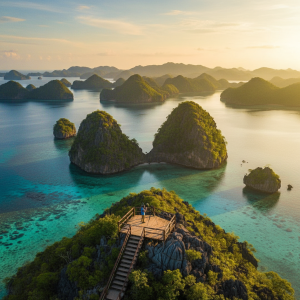
The Wayag Islands are the undisputed icon of Raja Ampat, the image that has launched a thousand expeditions. Reaching this remote northern archipelago requires a dedicated liveaboard journey, but the photographic reward is immeasurable. The classic shot is from the summit of Mount Pindito, a viewpoint that reveals a panoramic vista of countless conical karst islands scattered across a vast, turquoise lagoon. It is a scene of profound scale and symmetry, a cartographer’s dream rendered in emerald and sapphire.
The ascent to the main Wayag Islands viewpoint is a physical commitment. It is not a casual stroll but a short, sharp jungle trekking for views, involving scrambling over sharp limestone and using fixed ropes in steeper sections. Proper footwear is essential, and it is best undertaken in the cooler parts of the day. The effort, however, is immediately forgotten upon reaching the summit. The 360-degree view offers a multitude of compositions, from wide-angle panoramas capturing the entire archipelago to telephoto shots isolating specific island clusters and the intricate patterns of the shallow reefs below.
Timing is critical in Wayag. The midday sun can be harsh, creating high-contrast scenes with deep shadows and blown-out highlights. The true magic happens during the golden hours, but accessing the viewpoint for sunrise or sunset requires precise planning and an overnight stay in the sheltered anchorage. A professional photography guide is invaluable here, understanding the tidal patterns for safe tender landings and the exact positioning needed to capture the first or last light painting the tips of the karsts in warm, dramatic hues.
Pianemo Islands: The Accessible Icon
While Wayag represents the ultimate pilgrimage, the Pianemo Islands (often called ‘Little Wayag’) offer a similarly spectacular, albeit more accessible, karst island vista. Located in the Fam Islands group, Pianemo is a popular and well-managed destination. The primary viewpoint is reached via a sturdy, 340-step wooden staircase, making the ascent manageable for most visitors and allowing photographers to focus on their gear rather than the climb.
From the star-shaped viewing platform, the scene unfolds: a striking collection of limestone islets set within a protected bay, their verdant green tops contrasting with the impossibly clear, multi-toned water. The composition is more contained than Wayag’s sprawling panorama, which can be an advantage, allowing for tightly framed, powerful images. A circular polarising filter is an indispensable tool here, helping to cut through the surface glare, deepen the blue of the sky, and reveal the vibrant coral gardens just beneath the water’s surface.
Because of its accessibility, Pianemo can be busy. A key advantage of a specialised Raja Ampat photo tour is the ability to schedule visits outside of peak hours. Arriving early in the morning or later in the afternoon provides softer light and a more tranquil experience, allowing for unhurried composition. There are also several other vantage points in the area, including a secondary platform and opportunities for drone photography, which can capture the iconic ‘star’ shape of the main islet cluster from a unique aerial perspective.
Beyond the Icons: Hidden Landscape Gems
While Wayag and Pianemo are the headline acts, Raja Ampat’s photographic depth lies in its lesser-known locations. A truly comprehensive expedition moves beyond the famous viewpoints to explore the archipelago’s quieter, equally remarkable corners. These are the places that yield unique portfolio images, telling a deeper story of the region’s diversity.
Kabui Bay’s Hidden Passage
Separating the islands of Waigeo and Gam, Kabui Bay is a labyrinth of water passages, hidden coves, and dramatic limestone cliffs. Its most famous feature is a narrow channel that feels like a river flowing through a canyon of rock. Photographing here is an exercise in capturing mood and atmosphere, especially when the morning mist hangs low over the water. The famous ‘Batu Pensil’ (Pencil Rock), a solitary sea stack, provides a striking focal point for compositions within the bay.
The Fam Islands Archipelago
The broader Fam Islands group, where Pianemo is located, offers numerous other opportunities. Exploring by tender or kayak reveals secluded beaches, vibrant shallow reefs perfect for split-level shots, and countless unnamed karst islets. This area is superb for finding unique compositions away from the crowds, focusing on the intimate details of the landscape: the texture of the rock, the roots of trees clinging to cliffs, and the play of light on water.
The Crystalline World of Misool
In the south, the Misool archipelago presents a different character entirely. The karst formations here are often sharper, more jagged, and set against water of astonishing clarity. Locations like the Balbulol Lagoon, with its almost perfectly conical ‘Christmas tree’ islands, and the sacred Tomolol Cave system, offer profoundly different photographic challenges and rewards. Misool is a destination for the dedicated explorer, often requiring longer, more specialised liveaboard itineraries to do it justice.
Technical Craft: Mastering Light and Composition in the Tropics
The intense equatorial light and dynamic environment of Raja Ampat demand specific photographic techniques. Success here is a blend of preparation, adaptability, and a mastery of the fundamentals to control the challenging conditions.
Golden Hour and Blue Hour Strategies
The ‘golden hours’ around sunrise and sunset are fleeting near the equator. The light changes with astonishing speed, transitioning from soft pastels to harsh brightness in a matter of minutes. Being in position well before the best time for sunrise is non-negotiable. This is where a liveaboard-based tour excels, allowing photographers to wake up on location. Blue hour, the period just before sunrise or after sunset, can be equally productive, lending a cool, ethereal mood to seascapes, particularly for long exposure work.
Long Exposure and Seascape Compositions
The constant movement of the sea against the static, ancient karsts is a central theme of Raja Ampat’s landscape. Using neutral density (ND) filters to achieve long exposure seascapes can transform this dynamic into a serene, minimalist image. A 6-stop or 10-stop ND filter can smooth the water’s surface to a milky texture, emphasising the shapes and reflections of the islands. A sturdy travel tripod is essential, as is patience in finding a stable position on a beach, rocky outcrop, or even a tender boat in a calm bay.
Aerial Perspectives: Drone Photography
Drones have revolutionised landscape photography in Raja Ampat, revealing the sheer scale and intricate patterns of the archipelago. The top-down view of a reef system or the orbital shot around a karst pinnacle creates imagery impossible to achieve from the ground. Key drone photography spots include the heart-shaped lagoon in Misool, the star-cluster of Pianemo, and the grand panoramas of Wayag. Responsible piloting is paramount: respect wildlife, maintain line of sight, and be mindful of other visitors. A polarising filter for your drone’s camera is highly recommended to manage the intense glare off the water.
Planning Your Raja Ampat Photo Tour: Logistics and Timing
A successful photographic expedition to Raja Ampat hinges on meticulous planning. The region’s remoteness is both its charm and its primary logistical challenge. Unlike a standard holiday, a photography-focused trip requires an itinerary built around light, tides, and access to specific, often remote, locations.
The optimal season for landscape photography generally aligns with the calmer, drier months from October to April. During this period, the seas are flatter, making liveaboard travel more comfortable and transfers by tender to viewpoints and beaches safer. The skies are also clearer, offering a higher chance of dramatic sunrises and sunsets. The shoulder months can also be rewarding, with more dynamic cloud formations, but carry a higher risk of rain and rougher seas.
For the serious photographer, a liveaboard is the only practical means of exploring the full extent of Raja Ampat. It acts as a floating basecamp, eliminating wasted travel time and positioning you at key locations for the best morning and evening light. A dedicated Raja Ampat photo tour, led by a professional photographer, elevates this experience further. Such expeditions are curated specifically for image-making, with itineraries that prioritise photographic opportunities over a simple tourist checklist. The guidance of a leader who knows the tides, weather patterns, and secret vantage points is the single most valuable asset in maximising your creative output.
FAQ: Raja Ampat Landscape Photography
What is the absolute essential camera gear for Raja Ampat landscapes?
A weather-sealed camera body is highly advisable due to humidity and potential sea spray. A versatile wide-angle zoom (e.g., 16-35mm) is crucial for the grand vistas. A mid-range zoom (24-70mm) and a telephoto (70-200mm) are also vital for isolating details and compressing scenes. Do not forget a sturdy tripod, a circular polariser, and a set of ND filters (6 and 10-stop are most useful). Plenty of spare batteries and memory cards are a must.
How physically demanding are the viewpoint treks?
The difficulty varies. The trek to the main Wayag viewpoint is the most strenuous, involving a short but steep scramble over sharp limestone rock, often requiring the use of your hands. It demands good mobility and sturdy, closed-toe shoes. In contrast, the Pianemo viewpoint is reached via a well-maintained wooden staircase and is accessible to anyone with moderate fitness. Most other landscape opportunities are accessed directly from the beach or a tender boat with minimal hiking.
Are there facilities to charge camera batteries and laptops on a liveaboard?
Yes, all reputable liveaboards catering to photographers, such as those used for our expeditions, have dedicated camera rooms or stations with ample power sockets (usually international or European two-pin plugs). Power is typically available 24/7 from generators. It is wise to bring a multi-socket power strip to ensure you can charge multiple devices (camera batteries, drone, laptop, phone) simultaneously. Always confirm the socket type with your tour operator beforehand.
What are the regulations for drone photography in Raja Ampat?
Currently, drone regulations in Raja Ampat are not as strict as in many other parts of the world, particularly in the remote marine protected areas. However, this is subject to change. Responsible flying is key. You must respect wildlife (especially bird colonies), avoid flying over people or villages without permission, and adhere to the guidance of your tour leader. Some specific homestays or resorts may have their own rules. Always prioritise safety and environmental respect over getting the shot.
Is a waterproof camera bag necessary?
Absolutely. Your primary camera bag may not need to be fully submersible, but a high-quality, weather-resistant bag with a rain cover is essential. More importantly, a dedicated dry bag is non-negotiable for tender boat transfers. These small boat journeys from the liveaboard to shore are where your gear is most at risk from splashes and spray. A 10-20 litre dry bag is perfect for protecting your camera body and a lens or two during these critical transfers.
How do you manage lens changes in such a humid and salty environment?
Minimising lens changes is the best strategy. If you must change a lens, do so in a sheltered environment, like inside a cabin on the liveaboard, away from wind and spray. Turn the camera body off and face it downwards to prevent dust from settling on the sensor. Never change a lens on an open beach or in a moving tender boat. Keep a rocket blower and microfibre cloths handy to deal with any dust or moisture that does get on your gear.
What is the best time of day for photography in Raja Ampat?
The golden hours—the first and last hour of daylight—provide the most dramatic and colourful light for landscapes. The light is soft, warm, and creates beautiful long shadows that define the texture of the karst islands. The blue hour, just before sunrise and after sunset, is also excellent for moody, long-exposure seascapes. Midday light is very harsh and high-contrast, best used for underwater photography or scouting locations for a later shoot.
Can I photograph the night sky in Raja Ampat?
Yes, and it can be spectacular. The region has virtually no light pollution, offering incredibly dark skies. On clear, moonless nights, the Milky Way is breathtakingly bright. A fast, wide-angle lens (e.g., 24mm f/1.4) and a sturdy tripod are essential for astrophotography. Capturing the galactic core behind the silhouette of a karst island is a truly memorable shot. Check the moon phases when planning your trip if this is a priority for you.
Are there any cultural considerations when photographing landscapes?
While landscape photography is generally straightforward, some areas hold cultural significance. Certain bays, islands, or rock formations may be considered sacred by local communities. A knowledgeable guide will be aware of these sensitivities and ensure you are respectful. If your landscape composition includes a village or local people, even in the distance, it is always best to be discreet and respectful. Never enter a village and begin shooting without the guidance and permission brokered by your tour leader.
How important is a guide for landscape photography here?
For serious photography, a specialist guide is critical. A general tour guide will take you to the main spots, but a photography guide understands light, composition, and timing. They know which side of an island will be lit at sunrise, the exact tide level needed to reveal a certain beach, and where to find unique, un-crowded vantage points. They transform a trip from a sightseeing tour into a productive and efficient photographic expedition, saving you time and ensuring you are in the right place at the right time.
Join a Curated Expedition
Capturing the profound beauty of Raja Ampat’s landscapes requires more than just a ticket; it requires a meticulously planned journey. Our expeditions are designed by professional photographers for photographers, ensuring you are positioned for the best light and the most compelling compositions. We handle the complex logistics so you can focus entirely on your craft. To learn more about our upcoming, professionally-led Raja Ampat photo tour itineraries, please contact us at [email protected] or on WhatsApp at +62 811-3941-4563.