Updated: July 2026
A Price Guide for All-Inclusive Raja Ampat Photo Holidays
- Includes: Luxury accommodation, expert photographic instruction, all meals, diving, and marine park permits.
- Excludes: International airfare to Indonesia, camera equipment rental, and standard crew gratuities (10-15%).
- Value: The price reflects the complex logistics of operating in a remote archipelago and the high-caliber guidance of a professional photographer.
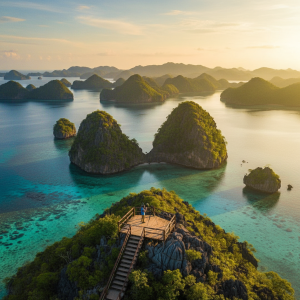
The air hangs thick and warm, scented with salt and damp earth. From the teak deck of the phinisi, the scene is almost impossibly primordial. Hundreds of conical karst islands, draped in emerald jungle, rise vertically from a sea of impossible turquoise. Below, a world of vibrant coral awaits. The only sounds are the gentle lapping of water against the hull and the deliberate, satisfying click of your camera’s shutter. This is not merely a vacation; it is a pilgrimage to the epicenter of marine life, an immersive experience designed for one purpose: to capture the profound beauty of the world’s last true paradise. And for those of us who travel with a lens, understanding the investment required for such an expedition is the first critical step in the journey.
Deconstructing the All-Inclusive Price Tag: What Are You Really Paying For?
When my editors at Departures first sent me to document Raja Ampat a decade ago, the term “luxury” in this part of the world was loosely defined. Today, the landscape has evolved dramatically. An all-inclusive Raja Ampat photo holiday is a meticulously orchestrated logistical ballet, and its price reflects three core pillars: access, expertise, and accommodation. Firstly, access in an archipelago of over 1,500 islands spread across 40,000 square kilometers is no small feat. The price includes not just your berth but the fuel to cover hundreds of nautical miles, from the famed lagoons of Wayag in the north to the otherworldly soft coral gardens of Misool in the south. It covers the essential Raja Ampat Marine Park Entry Permit (currently IDR 700,000, or about $45 USD) and the daily diving permits that fund conservation. This is your ticket to a region that, according to Indonesia’s official tourism board, is home to 75% of the world’s known coral species.
Secondly, there is the expertise. A true Raja Ampat Photo Tour is led not by a divemaster with a point-and-shoot, but by a seasoned professional photographer whose guidance is invaluable. Their fee is integrated into your cost. This is the expert who knows precisely when the sun will hit the Piaynemo viewpoint for the perfect starburst, who can teach you the nuances of snoot lighting for pygmy seahorses, and who will lead post-production workshops in the evening. Their knowledge transforms a trip from a series of great dives into a portfolio-building masterclass. Finally, the accommodation itself is a significant factor. We’re not talking about repurposed fishing boats. The vessels used for these top-tier expeditions are often bespoke phinisi schooners or modern motor yachts, representing an investment of millions of dollars, with a crew of 15 to 25 catering to just 12 to 16 guests.
The Liveaboard Tiers: From Boutique Comfort to Unrivaled Opulence
The vessel is your home, your transport, and your creative studio for the duration of the trip, and its caliber directly correlates with the price. Discerning the tiers is key to aligning your budget with your expectations. At the entry-level of luxury, what I call Boutique Comfort, you’ll find itineraries priced from $7,000 to $9,000 per person for a 10-day/9-night trip. These are often beautiful, traditionally-built wooden phinisis with 6-8 air-conditioned, en-suite cabins. The onboard experience is superb, with excellent food, a high level of service, and a dedicated camera room for gear prep. These operations provide fantastic value and access to the region’s greatest hits.
Moving up to the Premium Expedition tier, prices typically range from $9,500 to $13,000. Here, the vessels are often larger, offering greater stability and more spacious common areas and cabins. The crew-to-guest ratio often approaches 1:1. The defining feature of this tier is an elevated focus on the photographic process. You might find larger, climate-controlled camera rooms with multiple charging stations per guest, more powerful dive tenders for faster deployment, and occasionally, an itinerary that ventures further off the beaten path. The trip might be 11 or 12 days, allowing for a more relaxed pace and the ability to wait for perfect light or animal encounters. This is the sweet spot for serious hobbyists and aspiring professionals.
At the apex are the Elite Private Charter experiences. Here, per-person pricing becomes less relevant, as clients typically charter the entire vessel for rates starting at $80,000 and soaring past $150,000 per week. Vessels in this category, like the Aqua Blu or Prana by Atzaró, are floating five-star hotels. The itinerary is completely bespoke. If you wish to spend four days photographing the manta ray aggregation at ‘Manta Sandy,’ the captain will oblige. If your focus is on Birds of Paradise, the expedition leader will arrange pre-dawn treks with the best local guides. This is the ultimate expression of an all-inclusive Raja Ampat photo holiday, offering freedom and privacy.
The ‘All-Inclusive’ Fine Print: Budgeting for What’s Not Included
As any seasoned traveler knows, “all-inclusive” is a term that requires scrutiny. While the best operators are transparent, a successful trip requires budgeting for the inevitable ancillary costs. The most significant of these is airfare. Reaching Sorong (SOQ), the gateway to Raja Ampat, is an expedition in itself. From North America or Europe, expect at least two layovers, typically through a major Asian hub and then Jakarta (CGK) or Makassar (UPG). Round-trip economy fares can range from $1,800 to over $4,000, and it’s wise to book flights that arrive a full day before your boat’s departure to buffer against delays.
Next is crew gratuity. This is not a hidden fee but a deeply ingrained and appreciated custom. The crew works tirelessly, from the chefs and engineers to the dive guides who ensure your safety and find the most elusive critters. The industry standard is to tip 10-15% of the charter cost. For a $10,000 trip, this means budgeting an additional $1,000 to $1,500, typically paid in crisp US dollars or Indonesian Rupiah at the end of the journey. Another consideration is insurance. Every reputable operator will mandate both comprehensive travel insurance and specific dive accident insurance, such as a policy from Divers Alert Network (DAN). This is non-negotiable and will add another $200-$400 to your pre-trip expenses. Finally, while your package includes meals and non-alcoholic drinks, most boats run a tab for beer, wine, and spirits. Similarly, equipment rental for specialized gear like a high-end underwater strobe or a specific macro lens can add several hundred dollars to your final bill if you don’t bring your own.
Land-Based vs. Sea-Based: A Cost and Experience Comparison
While the liveaboard is the classic choice for a comprehensive photo tour, a handful of exceptional land-based resorts offer an alternative. Premier properties like Misool Eco Resort or Papua Explorers Dive Resort provide a compelling proposition, with costs that can be comparable to a mid-tier liveaboard, often averaging $800 to $1,200 per night for a full-board dive package. The primary advantage of a resort stay is stability and space. You have a private bungalow, resort amenities, and no chance of seasickness. For photographers with a very specific goal, such as documenting the incredible marine diversity within the Misool Private Marine Reserve, a week-long stay can be immensely productive.
However, for the photographer aiming to capture the full breadth of the Raja Ampat archipelago, a land-based stay is inherently limiting. Your photographic opportunities are confined to the resort’s daily boat range, typically a radius of 20-30 nautical miles. You cannot wake up at the Wayag viewpoint and then dive Misool the next day. A liveaboard’s core strength is its mobility. It is a floating basecamp that repositions while you sleep, dine, or edit photos. This allows a meticulously planned expedition for photographers to sequence iconic locations logically, following the best weather and tides. A liveaboard can cover the 120 nautical miles between the Dampier Strait and Misool over the course of an itinerary, offering a variety of subjects—from the wobbegong sharks of the north to the walking sharks of the south—that is simply impossible to achieve from a single land-based location.
Timing is Everything: How Seasonality Affects Your Investment
The price of your journey is inextricably linked to the seasons. Raja Ampat sits on the equator, but it experiences distinct microclimates and weather patterns that influence dive conditions and, consequently, demand. The peak season, running from roughly October through April, corresponds with the northwest monsoon. This period generally brings calmer seas and the best underwater visibility, often exceeding 30 meters. This is the high season for a reason; conditions are optimal for wide-angle photography of reefs and iconic landscapes. As a result, prices are at their highest, and the most sought-after boats and photo guides are often booked 18 to 24 months in advance.
The shoulder months of May and September can present a strategic opportunity for value. Conditions remain very good, but the transition between monsoons can bring slightly more variable weather. For this minor trade-off, you may find availability on shorter notice or even a 10-15% reduction in charter cost. I’ve had some of my most memorable encounters during these periods, with fewer boats at popular sites. The low season, from June to August, is defined by the southeast monsoon, which can bring stronger winds and surface chop, particularly impacting the southern region of Misool. Many liveaboards use this time for annual dry-docking or relocate to other parts of Indonesia like Komodo. While trips still run, especially in the more sheltered northern areas, it is generally not the ideal time for a first-time, all-encompassing photographic expedition. This is where the expertise of an operator like Rajaampat Phototour Co. becomes critical, as they can craft itineraries that maximize the potential of any given season, a nuance often missed by travelers booking directly.
Quick FAQ on All-Inclusive Raja Ampat Photo Holidays
Is a 7-day or 11-day trip better for photography?
For a serious photographer, an 11- or 12-day itinerary is vastly superior. The sheer scale of Raja Ampat means a 7-day trip barely scratches the surface and feels incredibly rushed. A longer trip allows for travel between distinct northern and southern ecosystems, provides crucial buffer days for inclement weather, and permits repeat visits to a site if a specific animal encounter doesn’t materialize on the first attempt. It’s an investment in maximizing your opportunities.
How much cash should I bring?
Despite the “all-inclusive” nature, cash is essential. For a 10-day trip, I recommend bringing $1,500 to $2,000 USD per person. This covers the crew gratuity, any onboard incidentals, and the chance to buy unique crafts in local villages. It’s vital to bring crisp, new US dollar bills, as older or marked notes are often rejected. ATMs are nonexistent beyond the port city of Sorong.
What makes this different from a regular dive trip?
The difference is the singular focus on creating images. A dedicated photo holiday features an itinerary dictated by light and tides, not just dive schedules. You’ll have longer bottom times to work with a subject, specific briefings on photographic techniques, and onboard workshops. The expedition leader is a professional photographer whose job is to help you improve your craft and come home with portfolio-worthy shots, a value proposition far beyond that of a standard dive guide.
Is Raja Ampat’s biodiversity really that special?
The numbers are staggering. As part of the Coral Triangle, a region on the tentative list for UNESCO World Heritage status, Raja Ampat holds the world record for fish species diversity on a single dive. Scientists have recorded over 1,600 species of fish and 600 species of hard coral. For an underwater photographer, there is no place on Earth that offers more subjects and more vibrant life in every frame.
Ultimately, an all-inclusive Raja Ampat photo holiday is an investment in an experience that transcends a typical vacation. It is a masterclass in photography, an education in marine biology, and a profound encounter with one of the planet’s last, truly wild places. logistics of such an undertaking requires a partner with unimpeachable expertise and deep local connections. The specialists at Rajaampat Phototour Co. do not just book trips; they curate expeditions designed to yield extraordinary results. Explore a premier raja ampat photo tour and begin crafting your own journey to the heart of the Coral Triangle.